Marine life
Giant Kelp Forest
Macrocystis pyrifera
Tasmania's underwater forests — dramatically diminished, and worth seeing while they remain.
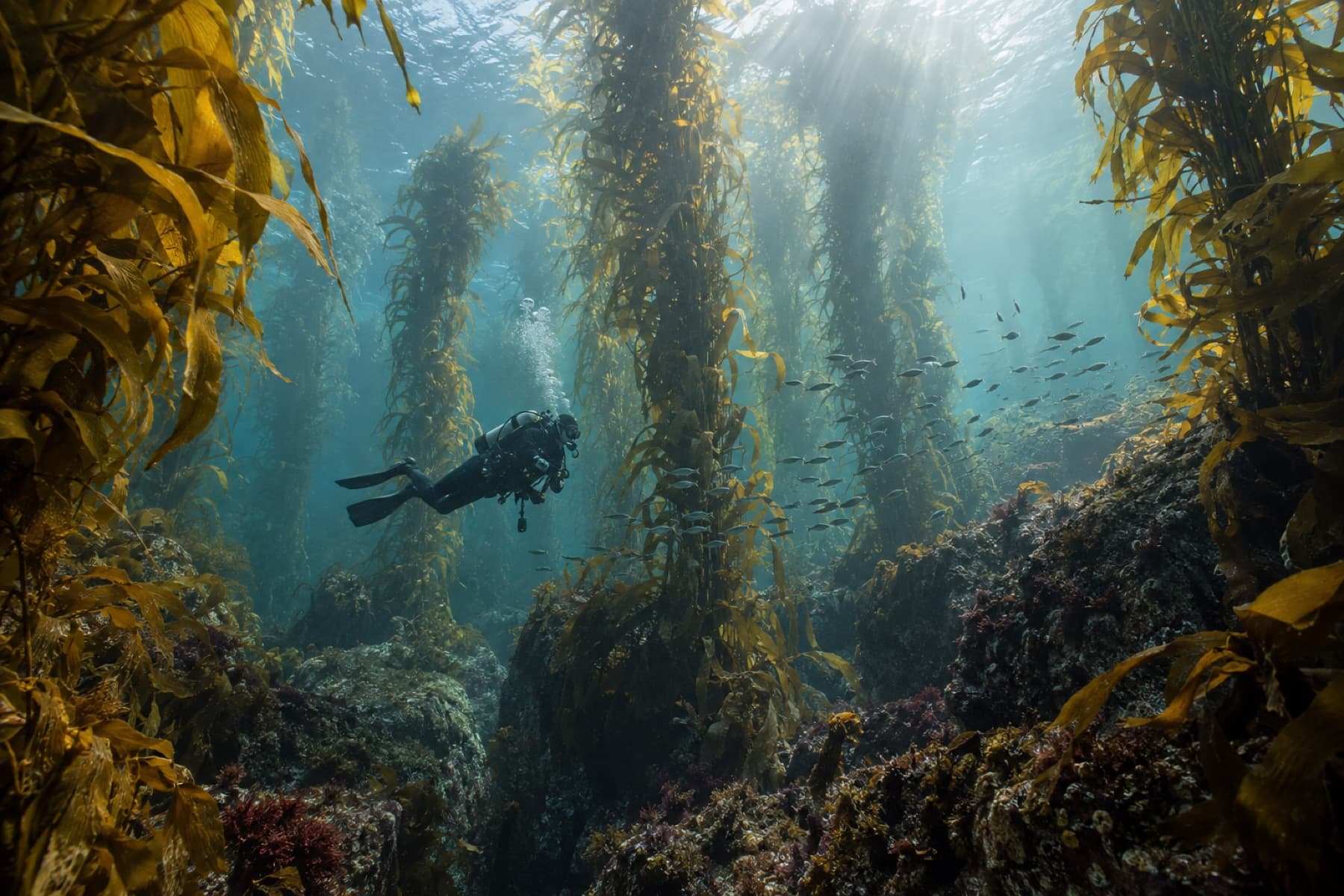
Giant kelp forms genuine underwater forests — fronds anchored to the seabed and held vertical by gas-filled floats, rising thirty metres to a canopy that filters the light into something closer to a cathedral than a reef.
Diving one is unlike anything else in Australian waters. The light, the movement in surge and the sheer vertical scale make it an experience of architecture rather than of marine life.
Tasmania's giant kelp forests have declined dramatically, and the surviving stands are listed as an endangered ecological community. Warming water carried south by a strengthening East Australian Current is the principal driver, alongside grazing by range-extending long-spined sea urchins.
| Scientific name | Macrocystis pyrifera |
|---|---|
| Typical size | Fronds to 30 m or more |
| Conservation status | Tasmanian giant kelp forests listed as an endangered ecological community |
| Peak months | June, July, August |
| Documented sites | 4 |
| States | Tasmania |
- long blade-like fronds with gas bladders at the base of each blade
- forms a surface canopy in healthy stands
- golden-brown, translucent in sunlight
- anchored by a holdfast rather than roots
Kelp forest is included here because it functions the way a headline species does: it is a reason to travel, it has a season, and it is in trouble.
It also supports everything else on a Tasmanian dive — the fish, the crayfish and the invertebrate life all depend on the structure.
In-water etiquette
Giant Kelp Forest is tasmanian giant kelp forests listed as an endangered ecological community. How divers behave around it genuinely matters.
- Avoid pulling on fronds to hold position.
- Take care with equipment and hoses — entanglement is a real consideration in dense stands.
- Follow local guidance; some stands are actively monitored and restored.
Where to see them
Sites where this species is documented as a reliable encounter.
Operators servicing those sites
Businesses documented as diving the sites above. Confirm seasonality and requirements directly.
Often seen on the same dives
Frequently asked questions
Where can I dive giant kelp in Australia?
Tasmania, principally the Tasman Peninsula and parts of the east coast and D'Entrecasteaux Channel. Extensive surface-canopy forests are now rare.
Why has it declined?
Warming water carried south by a strengthening East Australian Current is the main driver, compounded by grazing from range-extending long-spined sea urchins.
Last researched: September 2026. Dive businesses change frequently — confirm current services, prices and requirements directly with the operator before booking.