Marine life
Whale Shark
Rhincodon typus
The world's largest fish, and at Ningaloo an encounter you snorkel with rather than dive.
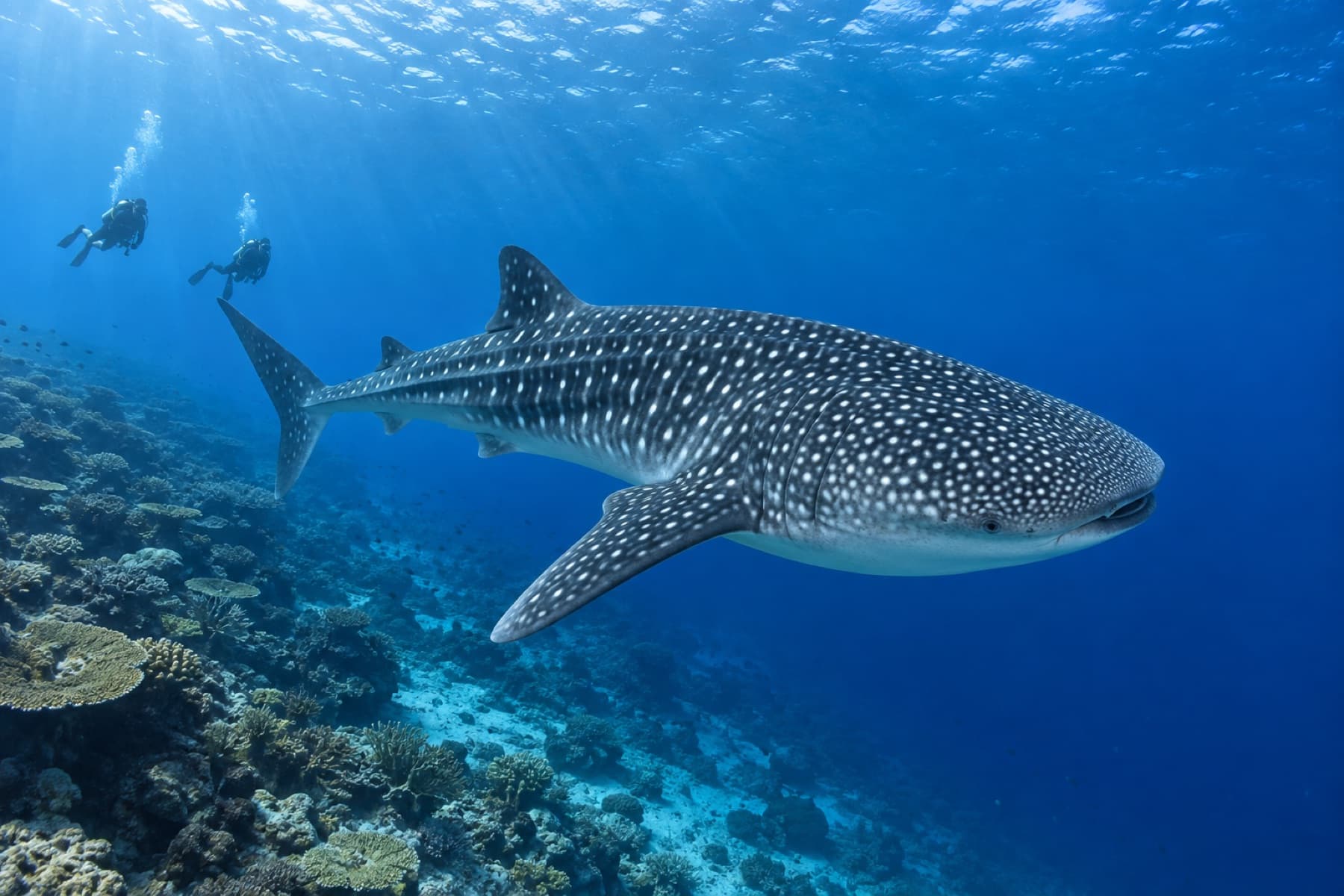
Whale sharks are the largest fish in the sea, filter feeders that cruise slowly near the surface with their mouths open, and Ningaloo Reef is one of the most reliable places on earth to encounter them.
The single most important thing for a visiting diver to understand is that this is almost always a snorkelling activity, not a scuba dive. Operators run spotter aircraft, position swimmers ahead of the animal and let it pass — bubbles and the noise of scuba gear tend to end the encounter early, and the regulations reflect that.
The Ningaloo aggregation follows the mass coral spawning in March, which triggers a plankton bloom, which brings the sharks. It is one of the more legible ecological chains in Australian diving: you can point at the cause.
| Scientific name | Rhincodon typus |
|---|---|
| Typical size | Commonly 4–10 m in Australian waters |
| Conservation status | Endangered |
| Peak months | April, May, June, July |
| Documented sites | 3 |
| States | Western Australia |
- enormous, broad flattened head with a terminal mouth
- distinctive pale spot-and-stripe checkerboard over dark blue-grey
- three prominent ridges along each flank
- slow, sweeping tail beat
- spot pattern behind the gills is unique to the individual, like a fingerprint
- Filter feeds on plankton, small fish and krill near the surface.
- Generally indifferent to swimmers, though it will dive to avoid crowding.
- Migratory — individuals photographed at Ningaloo have been matched to other Indian Ocean sites.
Online content routinely advertises "diving with whale sharks" at Ningaloo. In practice, interactions are conducted as snorkelling encounters.
Certified scuba diving at Ningaloo is a separate product, run on the reef and offshore sites, and a good operator will make the distinction clear at the point of booking. If it is not clear, ask directly which activity you are paying for.
In-water etiquette
Whale Shark is endangered. How divers behave around it genuinely matters.
- Follow the operator's positioning instructions — regulated minimum distances apply.
- Never swim in front of, or block the path of, the animal.
- Do not touch, and stay clear of the tail.
- No flash photography.
- Photograph the flank behind the gills if asked — operators contribute to identification databases.
Where to see them
Sites where this species is documented as a reliable encounter.
Operators servicing those sites
Businesses documented as diving the sites above. Confirm seasonality and requirements directly.
Often seen on the same dives
Frequently asked questions
Can you scuba dive with whale sharks at Ningaloo?
Interactions are generally run as snorkelling encounters rather than scuba dives. Operators offer certified scuba diving separately on the reef and offshore sites.
When is whale shark season at Ningaloo?
Broadly March to August, following the mass coral spawning and the plankton bloom it triggers.
Are sightings guaranteed?
No, though the Ningaloo season is unusually reliable and many operators offer a return trip if no shark is sighted. Confirm the specific policy when booking.
Last researched: September 2026. Dive businesses change frequently — confirm current services, prices and requirements directly with the operator before booking.