Dive Centres AustraliaSearch
Menu

Marine life

Spotted Eagle Ray

Aetobatus ocellatus

A spotted, long-tailed ray that flies rather than flaps — often seen in small squadrons over sand.

Spotted eagle rays are among the most elegant animals a diver will see in Australian waters — dark above with white spots, a pointed duck-like snout, and a whip tail considerably longer than the body.

They move with slow wingbeats that genuinely look like flight, often in small groups cruising over sand or along a reef edge, and they will usually keep a polite distance rather than approaching.

They feed by rooting in sand for molluscs and crustaceans, which is when divers get the closest views.
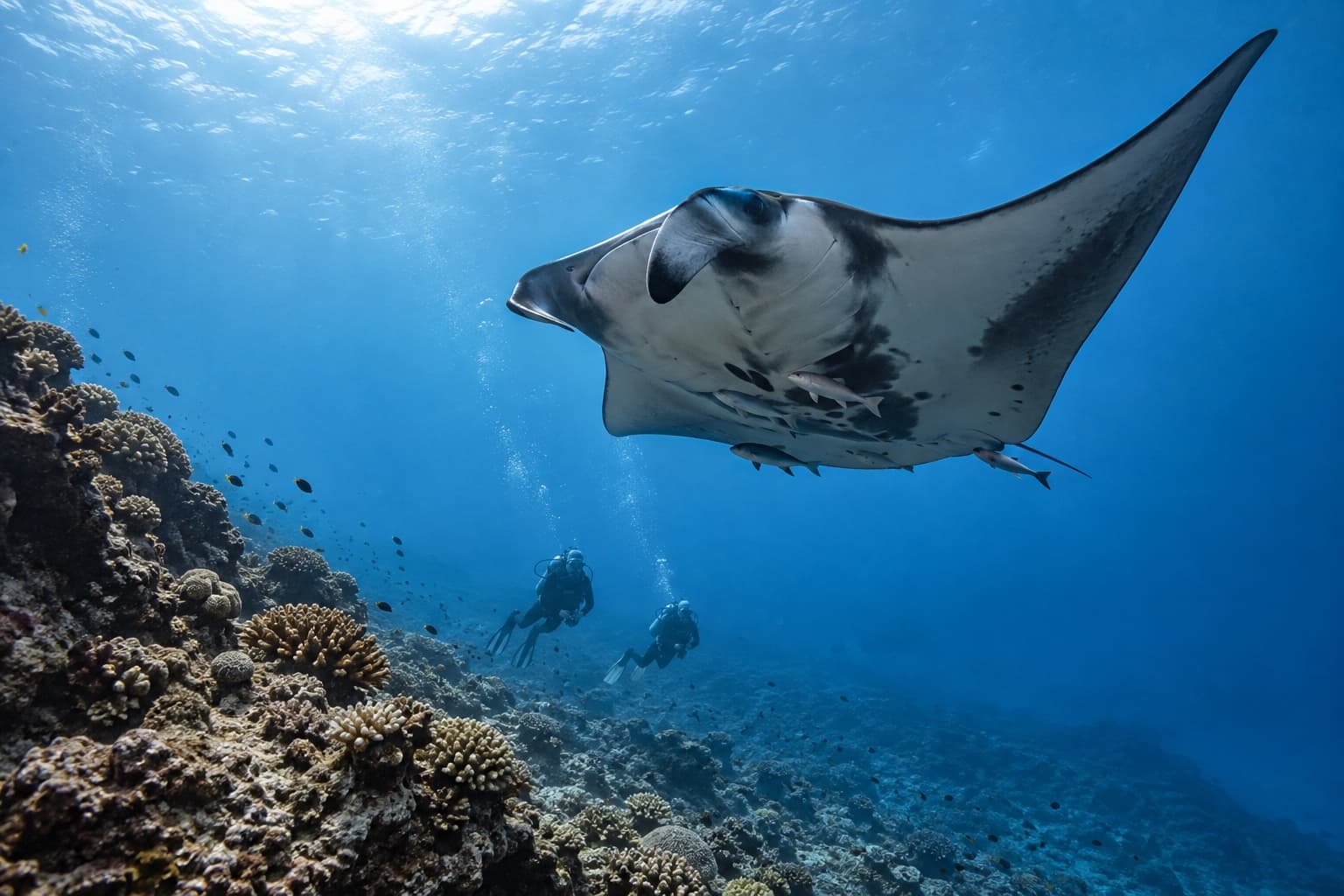
Manta ray gliding over a reef while scuba divers watch from a distance
A responsible manta encounter, represented by an AI-generated editorial image.
Scientific nameAetobatus ocellatus
Typical sizeCommonly 1.5–2.5 m wingspan
Peak monthsYear-round
Documented sites7
StatesNew South Wales, Queensland, Western Australia

When to see them

possible good peak
Encountered year-round across subtropical and tropical Australia.

Where they are

Julian Rocks (Nguthungulli)Flat RockCook IslandSS YongalaNingaloo ReefTangalooma WrecksWolf Rock
Documented sites for Spotted Eagle Ray. Hover a marker for the site name.

Identification

  • dark grey-black upper surface covered in white spots
  • pointed, duck-bill-shaped snout
  • very long whip-like tail with venomous spines at its base
  • flies with slow, deliberate wingbeats

Behaviour

  • Forages in sand for molluscs and crustaceans.
  • Often travels in small loose groups.
  • Generally shy of divers; approaches rarely work.

In-water etiquette

How divers behave around this species affects both the animal and everyone else's encounter.

  • Do not pursue — following a ray simply ends the encounter faster.
  • Stay clear of the tail base, which carries venomous spines.

Where to see them

Sites where this species is documented as a reliable encounter.

Operators servicing those sites

Businesses documented as diving the sites above. Confirm seasonality and requirements directly.

Sundive Byron BayA Byron Bay operation running daily Julian Rocks diving alongside introductory scuba and recreational training.Byron Bay Dive CentreA Byron Bay operation providing Julian Rocks diving and recreational training.Manta Lodge & Scuba CentreA North Stradbroke Island operation combining accommodation and diving, which makes it structurally different from a suburban Brisbane training centre.Gold Coast Dive CentreA Gold Coast training and service business serving local divers and visitors.Gold Coast Dive AdventuresA Gold Coast operation focused on guided local diving and charter access to offshore sites.Yongala DiveAn Ayr-based operation specialising in the SS Yongala, with a shorter boat transit to the wreck than Townsville departures.Adrenalin Snorkel & DiveA Townsville operation running SS Yongala trips alongside reef diving and training.Exmouth Dive & Whalesharks NingalooAn Exmouth operation running certified scuba diving alongside whale shark and other wildlife tours. The scuba and snorkelling products are distinct and should be booked deliberately.Ningaloo Reef DiveA Ningaloo operation based at Coral Bay providing reef diving and training.Dive NingalooAn Exmouth operation focused on certified scuba diving, including Navy Pier access.Ningaloo Blue DiveAn Exmouth operation running diving alongside wildlife tours. Product categories should be checked before booking.Sail NingalooA multi-day sailing and diving operation on Ningaloo Reef, offering a liveaboard-style format.

Often seen on the same dives

Last researched: September 2026. Dive businesses change frequently — confirm current services, prices and requirements directly with the operator before booking.