Byron Bay · New South Wales
Julian Rocks (Nguthungulli)
Where tropical and temperate waters meet — more than 20 shark and ray species recorded.
Julian Rocks lies approximately 2.5 kilometres from Byron Bay, inside the Cape Byron Marine Park. It is a short boat ride from the beach, which makes it one of the most accessible world-class dive sites in Australia.
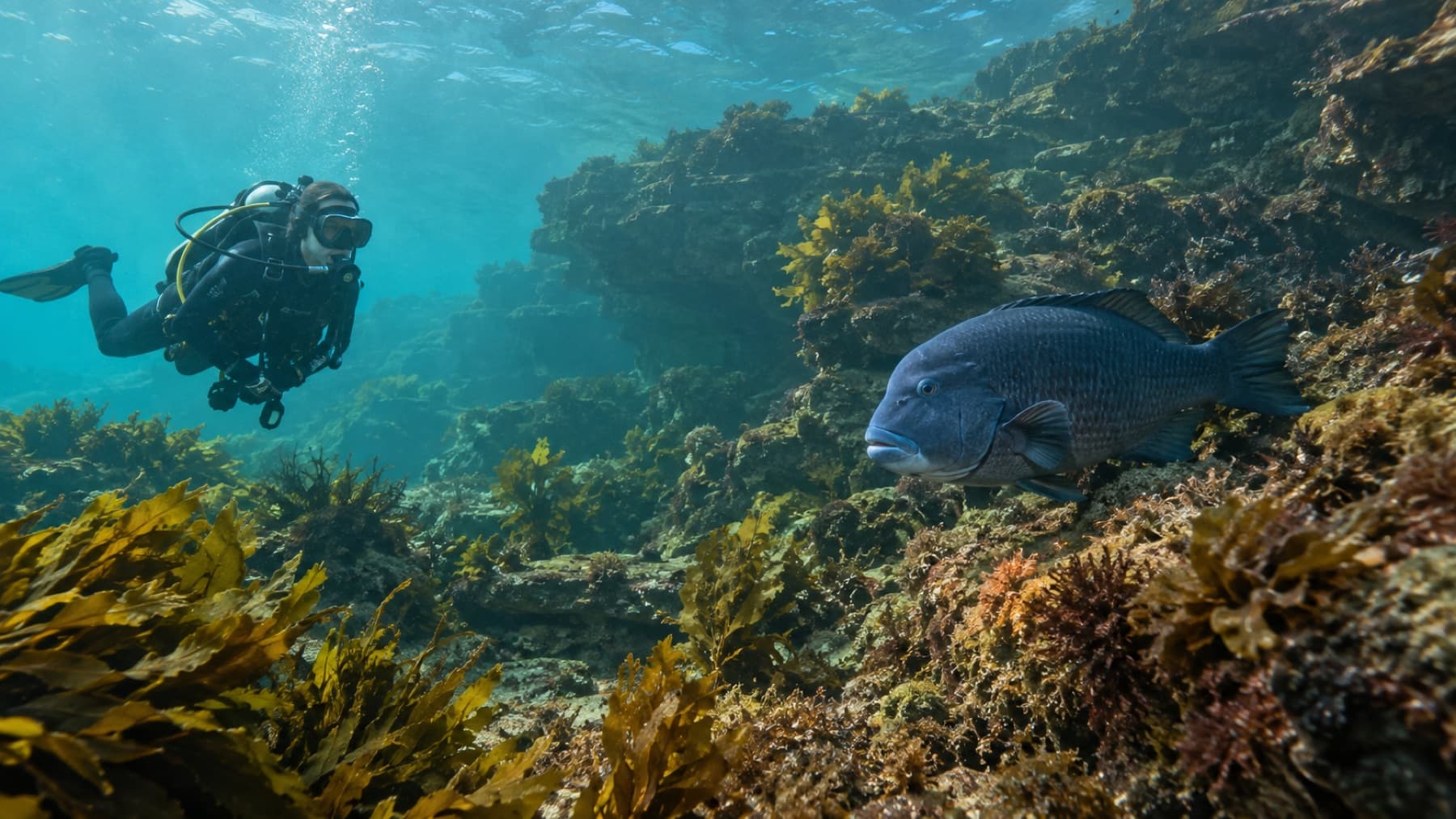
The ecological importance of the site comes from the meeting of tropical and temperate influences. Warm water arriving on the East Australian Current mixes with cooler temperate water, and species from both systems occur here together.
More than 20 species of sharks and rays have been recorded around the area. On a good day divers see leopard sharks, wobbegongs, rays and turtles on a single dive.
The site works for a wide range of experience levels because it offers shallow gutters and swim-throughs alongside deeper edges, and operators select the route to match the group and conditions.
Max depth
25 m
typically 15 m
Access
boat
Current
variable
Water temp
19–26°C
Level
advanced
| Region | Byron Bay |
|---|---|
| State | New South Wales |
| Access | boat |
| Site type | reef, island |
| Minimum depth | 4 m |
| Typical depth | 15 m |
| Maximum depth | 25 m |
| Current | variable |
| Visibility | Commonly 10–30 m |
| Water temperature | Roughly 19–26°C |
| Experience level | beginner, intermediate, advanced |
These are guidance categories, not guarantees. Conditions on the day, and an operator’s own requirements, override any classification here.
- loggerhead turtles
- green turtles
- leopard sharks
- grey nurse sharks
- manta rays
- eagle rays
- wobbegongs
- nudibranchs
- schooling trevally and kingfish
Seasonality
- Late summer commonly brings warmer water and strong tropical influence, including leopard sharks and manta rays.
- Cooler periods can increase the likelihood of grey nurse shark encounters.
- Humpback whales pass offshore during migration and are sometimes heard underwater.
The best period depends entirely on what the diver wants to see. Someone hoping for manta rays and leopard sharks should target late summer. Someone hoping for grey nurse sharks should target the cooler months.
This makes Julian Rocks an unusually good illustration of a general principle: seasonality questions about dive sites are usually really questions about species.
Julian Rocks is small enough that most of it is diveable across a few visits, and different features suit different conditions.
- the Nursery — shallow and sheltered, good for beginners
- Cod Hole — a short swim-through often holding wobbegongs and grey nurse sharks
- the Needles — pinnacles and swim-throughs
- Hugo's Trench — deeper terrain on the northern side
- Cray Cave — an overhead feature requiring appropriate conditions
Julian Rocks sits within a sanctuary zone of the Cape Byron Marine Park. Nothing may be taken, and the marine life is habituated to divers precisely because it has been protected.
Access
- Boat access from Byron Bay, typically a beach launch.
- Short transit — usually under fifteen minutes.
- Trips are weather-dependent given the exposed beach launch.
Hazards
- current, which varies across the site
- surge in the shallow gutters and swim-throughs
- boat traffic in the area
- overhead in the Cod Hole and Needles swim-throughs
What you might see here
Species documented at this site, with seasonality and etiquette on each page.
Operators servicing this site
Businesses documented as regularly diving this site. Only operators we have established a connection for are listed.
Training that is genuinely useful here
Not a list of everything available — the qualifications that actually change what you can do at this site.
Related dive sites
Worth reading alongside this one.
Dive sites nearby
Other documented sites within range, nearest first — useful for building a trip rather than a single dive.
Other dive businesses in the area
Not documented as servicing this site, but close enough to be useful for fills, hire or advice.
Frequently asked questions
How deep is Julian Rocks (Nguthungulli)?
Depths range from around 4 metres to roughly 25 metres, with a typical profile around 15 metres. Conditions and route selection change this considerably.
Is Julian Rocks (Nguthungulli) suitable for beginners?
It can be, in reasonable conditions and with appropriate supervision. Conditions on the day matter more than certification level, and operators may impose their own requirements.
How do you get to Julian Rocks (Nguthungulli)?
Access is boat based. Boat access from Byron Bay, typically a beach launch.
Is there current at Julian Rocks (Nguthungulli)?
Current is recorded as variable. Conditions vary daily and should be checked close to the day.
What will I see at Julian Rocks (Nguthungulli)?
Commonly reported marine life includes loggerhead turtles, green turtles, leopard sharks, grey nurse sharks, manta rays, eagle rays. Sightings are never guaranteed, and several species here are strongly seasonal.
When is the best time to dive Julian Rocks (Nguthungulli)?
Late summer commonly brings warmer water and strong tropical influence, including leopard sharks and manta rays. Cooler periods can increase the likelihood of grey nurse shark encounters. Humpback whales pass offshore during migration and are sometimes heard underwater. There is rarely a single best month — the right time depends on what you want to see.
Where is Julian Rocks (Nguthungulli)?
Julian Rocks (Nguthungulli) is in the Byron Bay region of New South Wales.
Last researched: September 2026. Dive businesses change frequently — confirm current services, prices and requirements directly with the operator before booking.