Marine life
Loggerhead Turtle
Caretta caretta
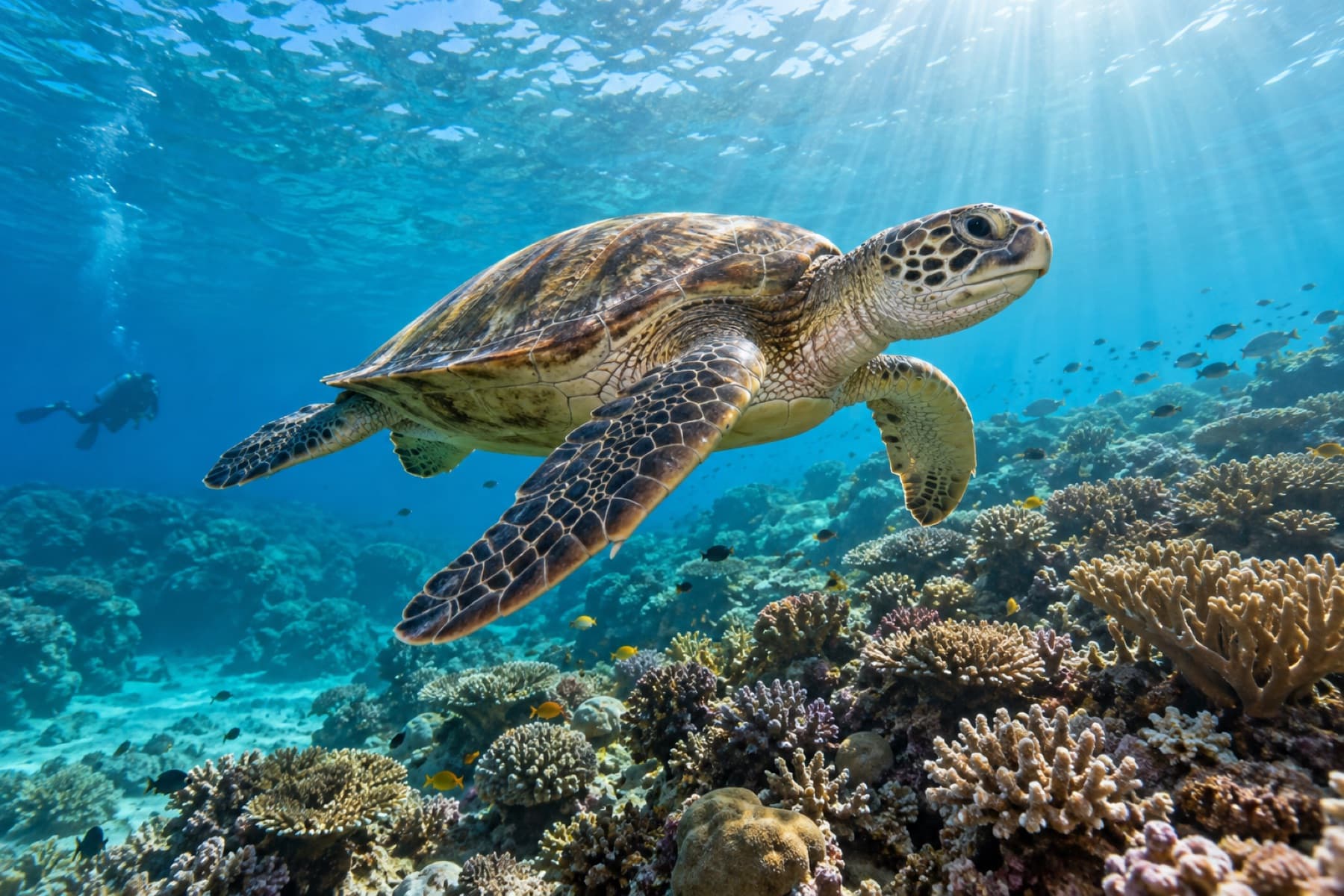
Heavier-headed and less common than the green turtle, with a nationally significant nesting population near Bundaberg.
Loggerheads are chunkier than green turtles, with a noticeably larger head and powerful jaws built for crushing molluscs, crustaceans and urchins.
The beaches around Bundaberg and the southern Great Barrier Reef support one of the most significant loggerhead nesting populations in the South Pacific, and the species is a regular sighting at Julian Rocks and Lady Elliot.
They are generally less tolerant of close approach than green turtles, so encounters tend to be shorter.
| Scientific name | Caretta caretta |
|---|---|
| Typical size | Shell commonly 80–110 cm |
| Conservation status | Endangered |
| Peak months | November, December |
| Documented sites | 4 |
| States | New South Wales, Queensland |
- two pairs of scales between the eyes
- large, broad head with heavy jaws
- reddish-brown, often thickly encrusted with barnacles
- shell tapers noticeably toward the rear
- Feeds on molluscs, crustaceans and urchins.
- Migrates long distances between feeding and nesting grounds.
- Less tolerant of close approach than green turtles.
In-water etiquette
Loggerhead Turtle is endangered. How divers behave around it genuinely matters.
- Never block the route to the surface.
- Do not touch or pursue.
- Respect nesting beach restrictions in season.
Where to see them
Sites where this species is documented as a reliable encounter.
Operators servicing those sites
Businesses documented as diving the sites above. Confirm seasonality and requirements directly.
Often seen on the same dives
Last researched: September 2026. Dive businesses change frequently — confirm current services, prices and requirements directly with the operator before booking.