Marine life
Grey Nurse Shark
Carcharias taurus
Australia's most recognisable dive shark — ragged teeth, entirely harmless, and critically endangered on the east coast.
The grey nurse shark is the animal most Australian divers picture when they imagine a shark dive, and it is almost entirely responsible for the reputation of sites like Fish Rock and Wolf Rock.
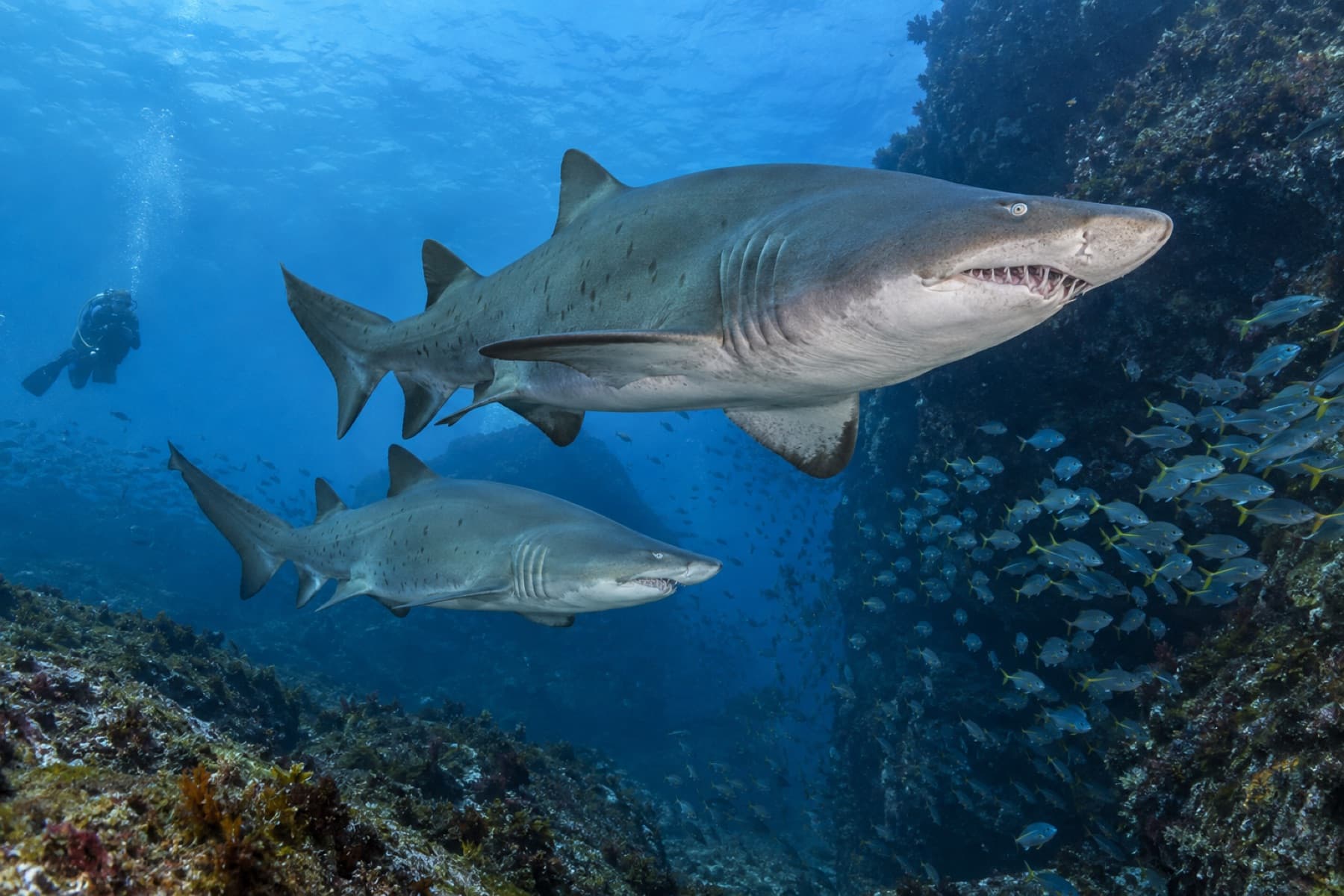
Its appearance does the species no favours. A mouthful of ragged, outward-pointing teeth that stay visible even with the jaw closed made it a target for decades of spearfishing and culling, largely on the assumption that anything that looks like that must be dangerous.
It is not. Grey nurse sharks feed on fish, squid and small rays, and there is no record of an unprovoked fatal attack on a diver in Australia. They hover almost motionless in gutters and caves, gulping air at the surface to fine-tune their buoyancy — a trick almost no other shark performs.
The east coast population is critically endangered, and that is the context for every encounter. Aggregation sites are a small number of specific gutters and caves along the coast, which is why those handful of places matter so much.
| Scientific name | Carcharias taurus |
|---|---|
| Typical size | Commonly 2–3 m |
| Conservation status | East coast population critically endangered |
| Peak months | May, June, July, August, September, October |
| Documented sites | 10 |
| States | New South Wales, Queensland, Western Australia |
- bronze-grey above, paler below, often with rusty spots on younger animals
- two dorsal fins of near-equal size, set well back
- conspicuous ragged teeth visible even when the mouth is closed
- stocky body, typically 2–3 m
- hovers with slow, minimal tail movement
- Aggregates in gutters, caves and overhangs, often in loose groups.
- Gulps air at the surface and holds it in the stomach for buoyancy control.
- Largely nocturnal feeder — daytime encounters are typically resting animals.
- Shows little reaction to calm divers and will usually maintain a steady patrol circuit.
Grey nurse sharks are not distributed evenly along the coast. They aggregate at a defined set of sites, most of which are protected as critical habitat.
Fish Rock at South West Rocks is the best known and the most reliable. Wolf Rock off Rainbow Beach is significant as one of the few sites where pregnant females gather. Flat Rock, the Solitary Islands, Broughton Island and Julian Rocks all produce regular encounters through the cooler months.
A critically endangered population that concentrates at a dozen specific gutters is unusually vulnerable. Damage to one site removes a meaningful fraction of available habitat.
This is why most aggregation sites sit inside marine park sanctuary zones, why fishing restrictions apply around them, and why operator behaviour at those sites is worth paying attention to when you choose who to dive with.
In-water etiquette
Grey Nurse Shark is east coast population critically endangered. How divers behave around it genuinely matters.
- Stay low and settle on the bottom rather than swimming into the gutter.
- Never block the aggregation's exit route — sharks that feel cornered leave the site.
- Do not chase, touch or attempt to ride. This is illegal as well as harmful.
- Keep group sizes sensible; several operators limit numbers at aggregation sites for exactly this reason.
- Avoid excessive strobe use on resting animals.
Where to see them
Sites where this species is documented as a reliable encounter.
Operators servicing those sites
Businesses documented as diving the sites above. Confirm seasonality and requirements directly.
Often seen on the same dives
Frequently asked questions
Are grey nurse sharks dangerous to divers?
No. They feed on fish, squid and small rays, and there is no record of an unprovoked fatal attack on a diver in Australia. Their appearance is the reason for the reputation, not their behaviour.
What is the best site in Australia to dive with grey nurse sharks?
Fish Rock at South West Rocks is the most consistently reliable. Wolf Rock, Flat Rock and the Solitary Islands are the other major sites, each with a different seasonal pattern.
Do I need an advanced certification?
It depends on the site rather than the shark. Fish Rock and Wolf Rock are demanding dives because of depth and current; Julian Rocks is accessible to newly certified divers.
Last researched: September 2026. Dive businesses change frequently — confirm current services, prices and requirements directly with the operator before booking.