Marine life
Leopard Shark (Zebra Shark)
Stegostoma tigrinum
A docile, spotted bottom-resting shark that arrives on the east coast with summer's warm water.
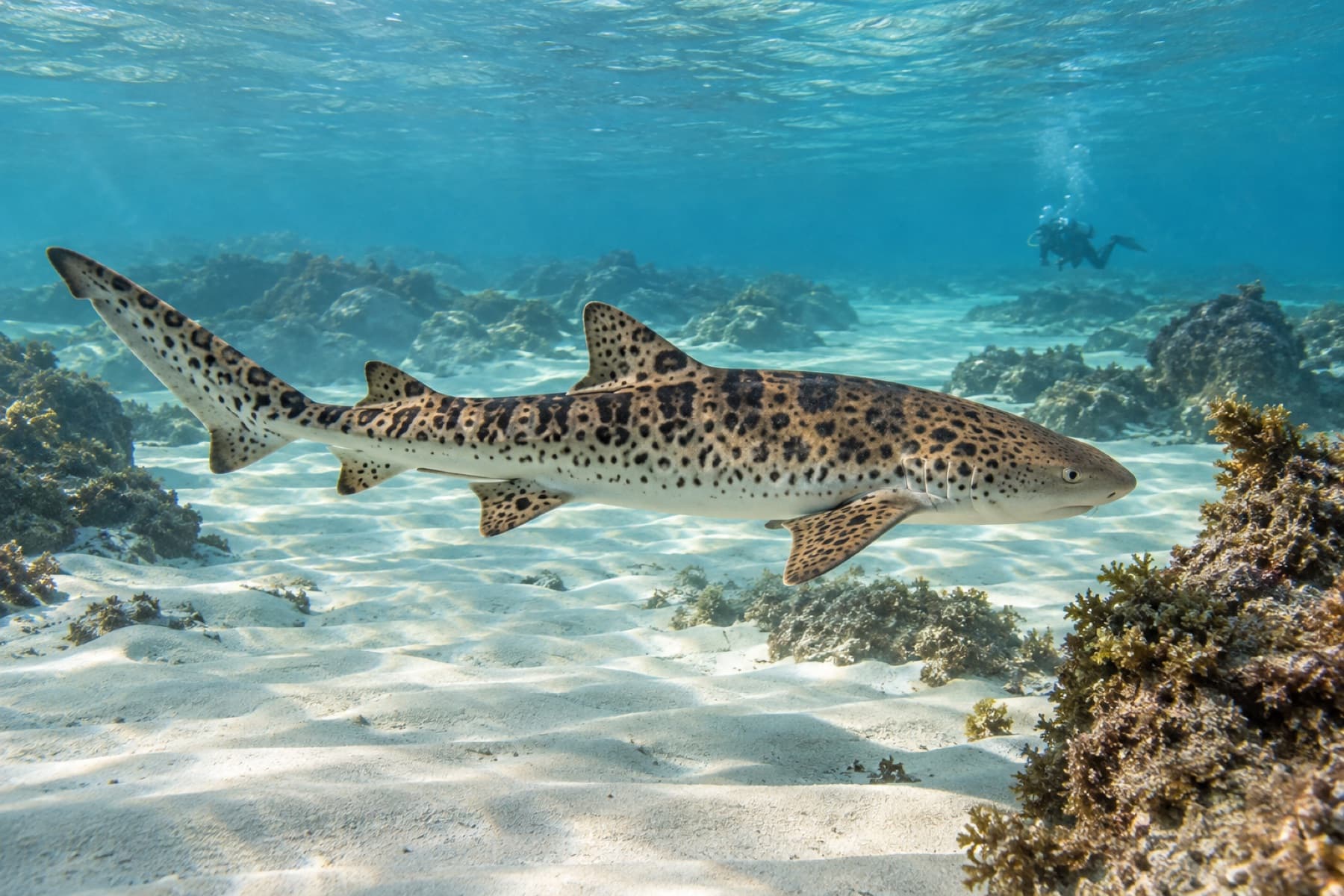
Leopard sharks — confusingly also called zebra sharks, because the juveniles are striped rather than spotted — are among the most approachable large animals an Australian diver will meet.
They spend most of the day resting motionless on sand, propped on their pectoral fins, facing into the current. A diver can settle nearby and watch for the whole dive without the animal reacting.
On the east coast they are a seasonal marker. Their arrival at Julian Rocks and Cook Island signals that the East Australian Current has pushed warm tropical water far enough south, and their departure marks the turn toward grey nurse season.
| Scientific name | Stegostoma tigrinum |
|---|---|
| Typical size | Commonly 2–2.5 m |
| Conservation status | Endangered globally |
| Peak months | January, February, March, December |
| Documented sites | 5 |
| States | New South Wales, Queensland |
- pale tan body covered in dark brown spots
- very long upper tail lobe, roughly half the total body length
- prominent longitudinal ridges along the body
- small mouth set well forward, beneath the snout
- juveniles are dark with pale stripes, not spots
- Rests on sand during the day, typically facing into current.
- Feeds nocturnally on molluscs, crustaceans and small fish.
- Highly tolerant of divers and will usually stay put unless crowded.
In-water etiquette
Leopard Shark (Zebra Shark) is endangered globally. How divers behave around it genuinely matters.
- Approach slowly and from the side, never head-on.
- Settle at a distance rather than swimming directly over the animal.
- Do not touch the tail or attempt to make it move for a photograph.
Where to see them
Sites where this species is documented as a reliable encounter.
Operators servicing those sites
Businesses documented as diving the sites above. Confirm seasonality and requirements directly.
Often seen on the same dives
Frequently asked questions
Are leopard sharks dangerous?
No. They are docile bottom-feeders with small mouths, and they tolerate divers unusually well.
When can I see leopard sharks in Australia?
Summer, broadly December to April on the northern NSW and southern Queensland coast. Julian Rocks and Cook Island are the most reliable sites.
Last researched: September 2026. Dive businesses change frequently — confirm current services, prices and requirements directly with the operator before booking.