
Technical training
Sidemount Diver Course in Australia
Carrying cylinders at your sides — redundancy, streamlining and access through restrictions.
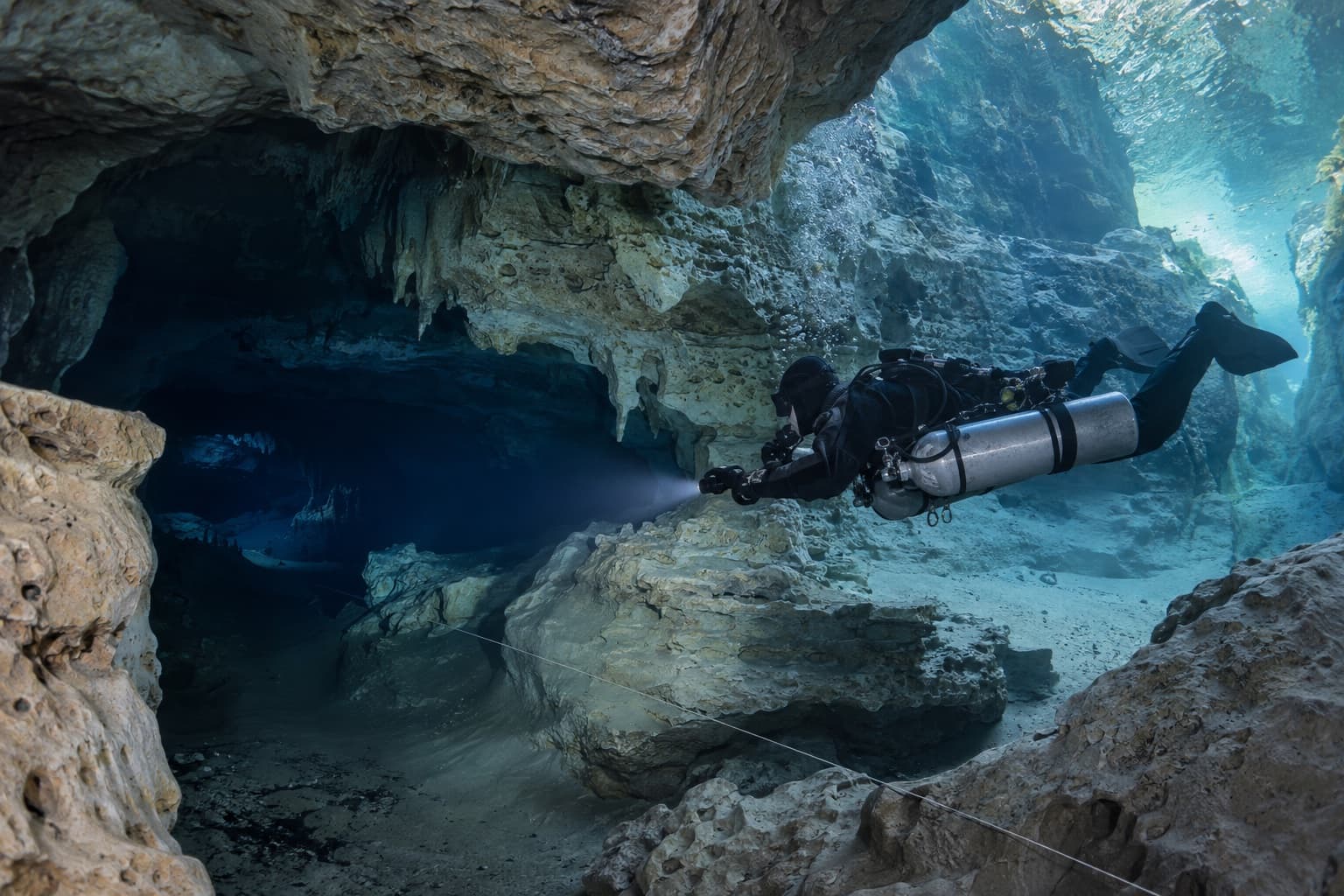

Sidemount configuration mounts cylinders along the diver's sides rather than on the back, which provides full gas redundancy with independent cylinders and a lower, more streamlined profile.
It originated in cave diving, where restrictions make a backmounted twinset impractical, and has since become popular well beyond that context — including with recreational divers who simply find it more comfortable.
It also allows a diver to don and doff cylinders in the water, which matters for shore entries, boat ladders and anyone with back or shoulder issues.
| Track | Technical |
|---|---|
| Prerequisites | Advanced Open Water or equivalent; Good buoyancy and trim; Some agencies require Nitrox |
| Agency equivalents | PADI: Sidemount Diver · SSI: Sidemount Diving · TDI: Sidemount Diver · RAID: Sidemount |
- sidemount harness setup and cylinder rigging
- gas switching between independent cylinders
- trim and buoyancy with side-mounted cylinders
- valve and regulator management
- donning and doffing cylinders in water
- propulsion techniques for restricted spaces
Independent cylinders mean a failure affects only half your gas. Streamlining improves in restricted spaces. Cylinders can be removed and handed through a restriction.
For divers with back problems, carrying two cylinders separately to the water rather than one heavy twinset is a decisive practical advantage.
With independent cylinders, a diver must switch regulators regularly to keep the cylinders balanced, both for gas reserves and for trim.
It is a discipline that becomes automatic quickly but has to be learned deliberately — a sidemount diver who forgets to switch ends the dive with one full and one empty cylinder.
Readiness
- Stable buoyancy and trim should exist before cylinders are moved to the diver's sides.
- Recreational sidemount, decompression sidemount and cave sidemount are different training goals.
- Use the same harness, cylinders and regulators during training that you expect to use afterwards where practical.
What to compare
- Compare instructors by the environments in which they actually use sidemount, not by the number of equipment brands they sell.
- Confirm whether the course covers independent-cylinder gas management, shutdowns, propulsion, restriction work and stage handling.
- A warm-water aluminium-cylinder configuration does not transfer unchanged to southern steel-cylinder diving.
Useful outcome
- The diver should be able to configure, trim and manage two independent cylinders without losing awareness of gas balance.
- The qualification does not itself grant decompression or cave privileges.
Questions to ask the instructor
- Which cylinders will be used?
- Is the goal recreational, wreck, decompression or cave sidemount?
- How much confined-water configuration time is included?
Dive Sites for Sidemount Diver Skills
Sites where holding this certification genuinely changes what you can do — not a list of everywhere it is accepted.
Courses After Sidemount Diver
Courses that build directly on this one.
Sidemount Diver Prerequisite Courses
Sidemount Diver Course Names by Training Agency
Agency versions and nearest equivalents. Names, prerequisites and limits can differ, so operators assess the exact certification and experience.
Australian Dive Centres Offering Sidemount Diver
Businesses where the relevant capability is verified or advertised. Always confirm the specific course directly.
Sidemount Diver Guides and Comparisons
Planning guides and comparisons connected to the skills on this course.
Sidemount Diver Course FAQs
Is sidemount only for cave divers?
No. It originated in caves but is now widely used recreationally and in wreck diving, and many divers prefer it purely for comfort and redundancy.
Can I use sidemount for recreational dives?
Yes, and many divers do. The configuration provides redundancy that a single-cylinder setup does not.
Sources
What the verified statements on this page are based on. We link primary sources so you can check them yourself — and so you can see the date they were consulted.
- SSI — Extended Range trainingchecked September 2026
- TDI — current diver standardschecked September 2026