
Technical training
Cave Diver Course in Australia
Full overhead penetration diving, where direct ascent is not available at any point.
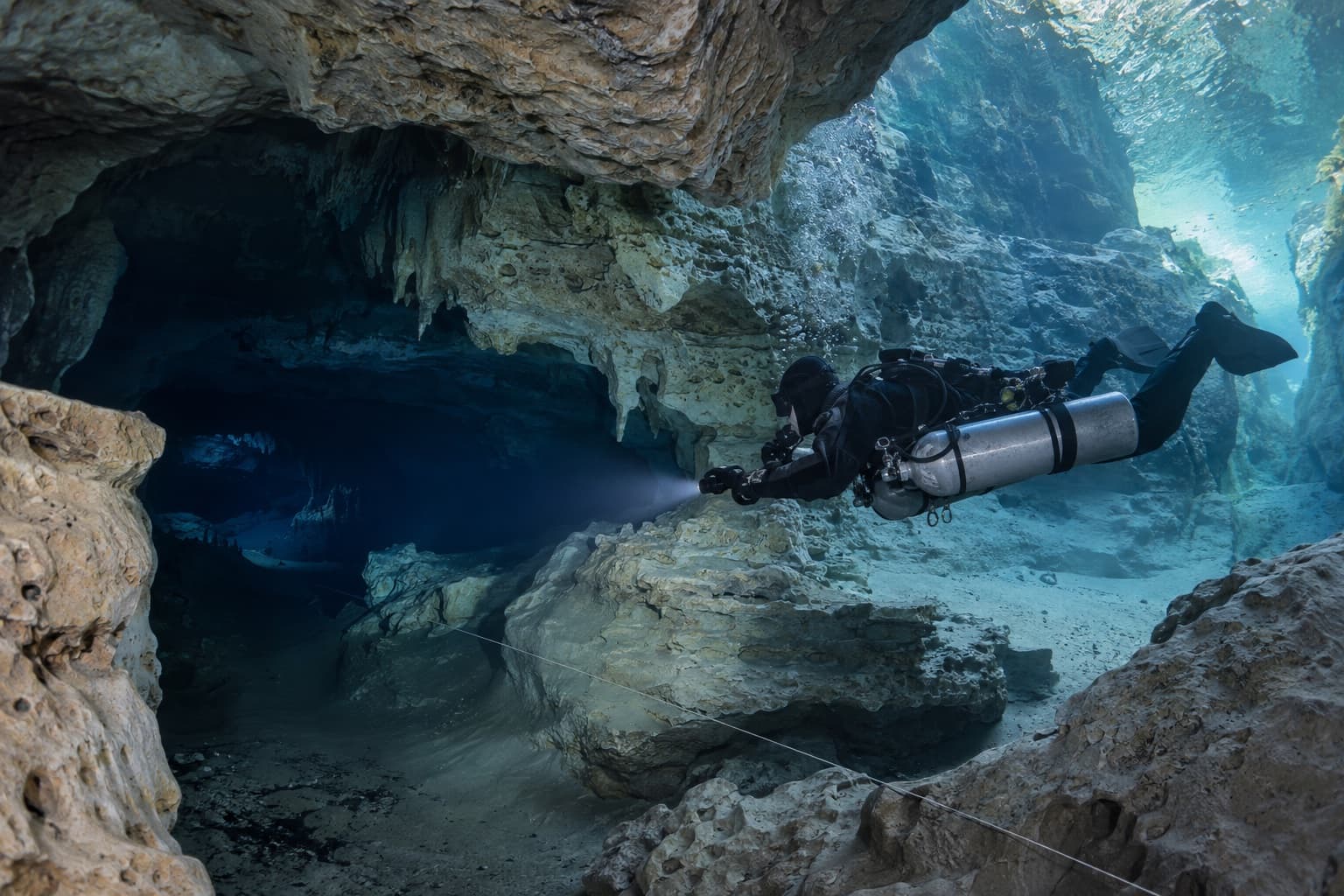

Cave diving is a separate discipline rather than an extension of recreational or even technical open-water diving, and its defining feature is the absence of direct ascent.
Everything else follows from that single fact: continuous guideline, conservative gas rules, redundant gas and lights, silt management, restriction technique and complex navigation.
In Australia, cave diving centres on the limestone of South Australia's Lower South East — Tank Cave, Piccaninnie Ponds, Kilsby's and many others — where access is governed by the Cave Divers Association of Australia.
| Track | Technical |
|---|---|
| Prerequisites | Cavern Diver; Advanced Nitrox typically required; Excellent buoyancy and trim; CDAA membership for Australian site access |
| Agency equivalents | TDI: Full Cave Diver · IANTD: Cave Diver · CDAA: Advanced Cave / Penetration |
- continuous guideline procedures and line laying
- lost line and lost diver protocols
- gas rules such as the rule of thirds and beyond
- light failure procedures with full redundancy
- silt management and precise propulsion technique
- restriction technique and equipment configuration
- complex multi-branch navigation with markers
A standard Open Water, Advanced or Deep certification does not prepare a diver to enter an overhead cave environment. This is not caution — the failure modes are genuinely different.
A diver who loses gas in open water ascends. A diver who loses gas in a cave has a distance problem, not a depth problem.
The Cave Divers Association of Australia operates the site classification system that determines which qualifications permit access to which sites, and membership is generally the mechanism by which access is granted at all.
The system exists because of a history of fatalities in the region, and the rules are specific responses to how those incidents happened.
Readiness
- Full cave training requires calm execution of failures in zero visibility, while sharing gas and maintaining contact with a guideline.
- Recent cavern or introductory cave experience matters more than collecting the next card quickly.
What to compare
- Agency pathways divide cavern, introductory and full cave capability differently. Compare penetration, navigation, stage, depth and decompression limits.
- For Mount Gambier, confirm how the course interfaces with current CDAA categories and site access.
Useful outcome
- The qualification should create conservative cave-dive planning and reliable team procedures, not merely permission to enter more sites.
Questions to ask the instructor
- How many caves and distinct conditions are used?
- What happens if visibility or access prevents a required dive?
- Which CDAA recognition or site access follows?
Dive Sites for Cave Diver Skills
Sites where holding this certification genuinely changes what you can do — not a list of everywhere it is accepted.
Courses After Cave Diver
Courses that build directly on this one.
Cave Diver Prerequisite Courses
Cave Diver Course Names by Training Agency
Agency versions and nearest equivalents. Names, prerequisites and limits can differ, so operators assess the exact certification and experience.
Australian Dive Centres Offering Cave Diver
Businesses where the relevant capability is verified or advertised. Always confirm the specific course directly.
Cave Diver Guides and Comparisons
Planning guides and comparisons connected to the skills on this course.
Cave Diver Course FAQs
Can I cave dive in Australia with an overseas cave certification?
CDAA recognises certain external qualifications for equivalence, but site access still runs through the CDAA system. Check the current arrangements before travelling.
Do I need sidemount for cave diving?
It depends on the site. Restrictions in systems like Tank Cave make sidemount configurations common, while more open systems accommodate backmount twinsets.
Sources
What the verified statements on this page are based on. We link primary sources so you can check them yourself — and so you can see the date they were consulted.
- TDI — current diver standardschecked September 2026
- CDAA — Cave Divers Association of Australiachecked September 2026