Marine life
Giant Australian Cuttlefish
Sepia apama
The world's largest cuttlefish, gathering in tens of thousands at Whyalla each winter.
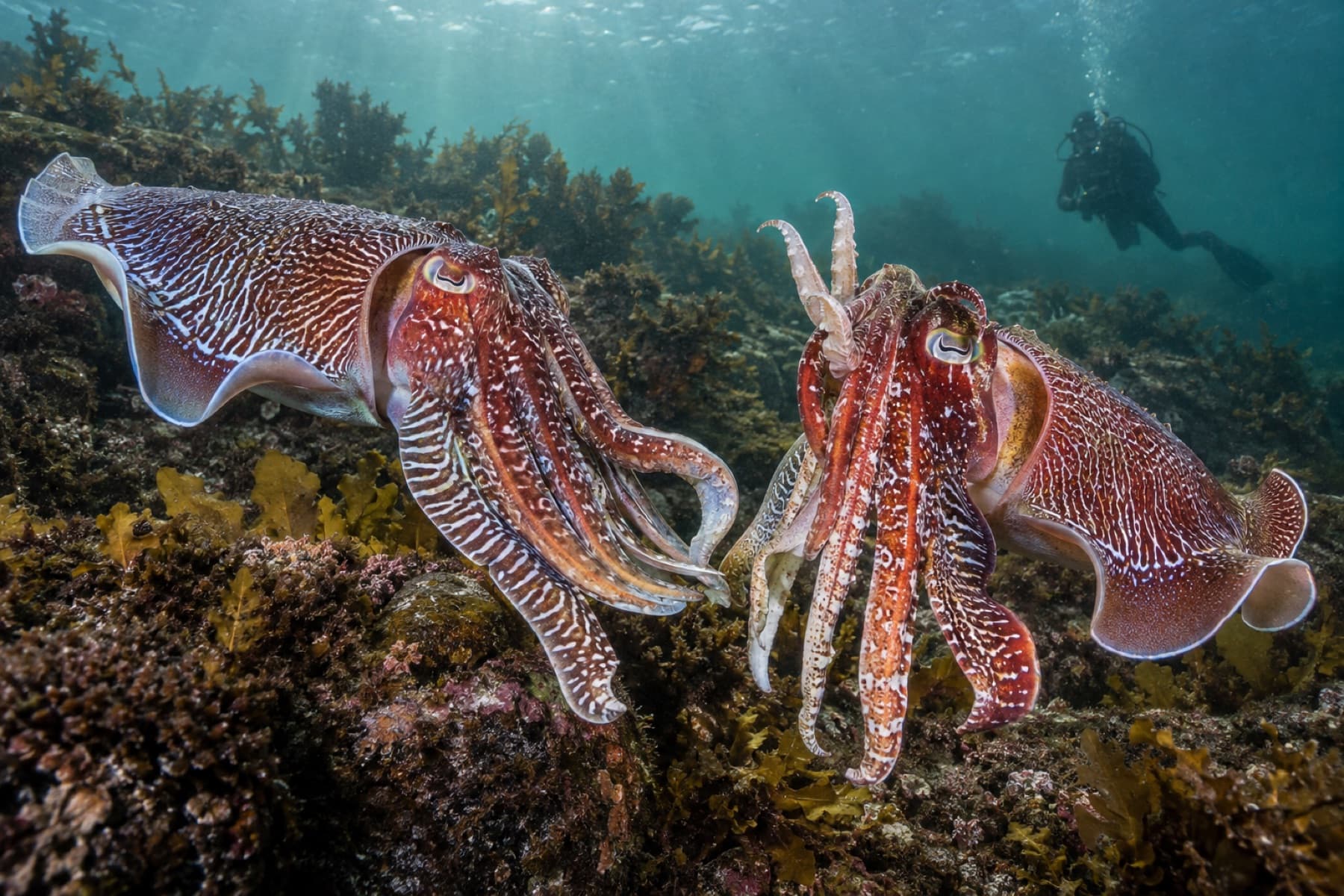
Giant Australian cuttlefish are the largest cuttlefish species in the world, and each winter tens of thousands of them gather in the shallows of the upper Spencer Gulf near Whyalla to breed.
It is one of the very few marine spectacles anywhere that is both reliably predictable and accessible from shore, in water shallow enough that snorkellers see it as well as divers do.
The behaviour is what makes it extraordinary rather than the numbers. Males compete for females with escalating displays of colour and pattern that ripple across the body in seconds, and smaller males mimic female colouration to sneak past larger rivals — a genuinely famous piece of animal behaviour that you can watch from a metre away.
| Scientific name | Sepia apama |
|---|---|
| Typical size | Up to around 50 cm mantle length |
| Peak months | May, June, July, August |
| Documented sites | 5 |
| States | South Australia, New South Wales |
- broad mantle with a fringing fin running the full body length
- eight arms plus two longer retractable tentacles
- W-shaped pupil
- colour and texture change continuously — there is no fixed appearance
- Males display with rapid, rippling colour and pattern changes to compete and court.
- Smaller males mimic female colouration to approach guarded females.
- Adults die after breeding, so the aggregation ends fairly abruptly.
- Can change skin texture as well as colour, raising papillae to match weed and rock.
Much of the aggregation happens in two to five metres of water. Snorkelling is entirely viable and for many visitors it is the better option — less equipment and less cold-water exposure planning.
What is not optional is thermal protection. This is winter diving in South Australia at around 13–16°C, and how long you can stay in is what determines how much behaviour you actually see.
In-water etiquette
How divers behave around this species affects both the animal and everyone else's encounter.
- Do not touch, chase, block or harass — this is a breeding aggregation and disruption has a real cost.
- Approach slowly and let animals come to you; undisturbed cuttlefish will continue displaying.
- Avoid excessive strobe use.
- Stay off the bottom where eggs are laid under rock ledges.
Where to see them
Sites where this species is documented as a reliable encounter.
Operators servicing those sites
Businesses documented as diving the sites above. Confirm seasonality and requirements directly.
Often seen on the same dives
Frequently asked questions
When is the Whyalla cuttlefish aggregation?
Approximately May to August, peaking in June and July. Numbers vary year to year, so check locally before travelling.
Do I need to be a certified diver to see it?
No. Much of the activity happens in a few metres of water and snorkelling works well. Cold-water exposure protection matters more than certification.
Why do the cuttlefish die afterwards?
Giant Australian cuttlefish are semelparous — they breed once and die. This is why the aggregation ends abruptly and why disrupting breeding behaviour has a genuine cost.
Last researched: September 2026. Dive businesses change frequently — confirm current services, prices and requirements directly with the operator before booking.