Australian Capital Territory dive centres
No coastline, but a substantial diving community served by full training, servicing and cylinder facilities.
Canberra has no coastline, but that does not prevent it supporting a substantial diving community. An inland dive centre simply serves a different function from a Cairns reef operator.
Canberra businesses primarily provide theory and confined-water training, equipment sales and servicing, cylinder services, fills, dive clubs, organised coastal trips and travel. They are logistics and support hubs rather than dive-site access points.
That model has a genuine advantage that holiday certification does not. A holiday-only course tends to end when the holiday ends. A local centre can keep supporting a diver afterwards with continuing education, club trips, servicing and someone to dive with.
For an inland diver, an active club is particularly valuable because it solves one of scuba's biggest practical problems: finding people to dive with.
Australian Capital Territory is organised by region because conditions, marine life and the kind of business that survives locally vary enormously within the state.
- Local theory and confined-water training
- Equipment sales, rental and servicing
- Cylinder hydrostatic testing and visual inspection
- Air, Nitrox and oxygen fills
- Active dive clubs
- Organised coastal trips to the NSW south coast
- Dive travel booking
| Water temperature | Not applicable locally. ACT divers generally dive the NSW south coast, where water ranges roughly 14–22°C depending on season. |
|---|---|
| Visibility | Determined by the coastal destination rather than the ACT itself. |
| Season | Training runs year-round. Open-water work and club trips are scheduled around coastal conditions, most commonly toward Jervis Bay and the south coast. |
| Regions documented | 1 |
| Businesses documented | 2 |
| Dive sites documented | 0 |
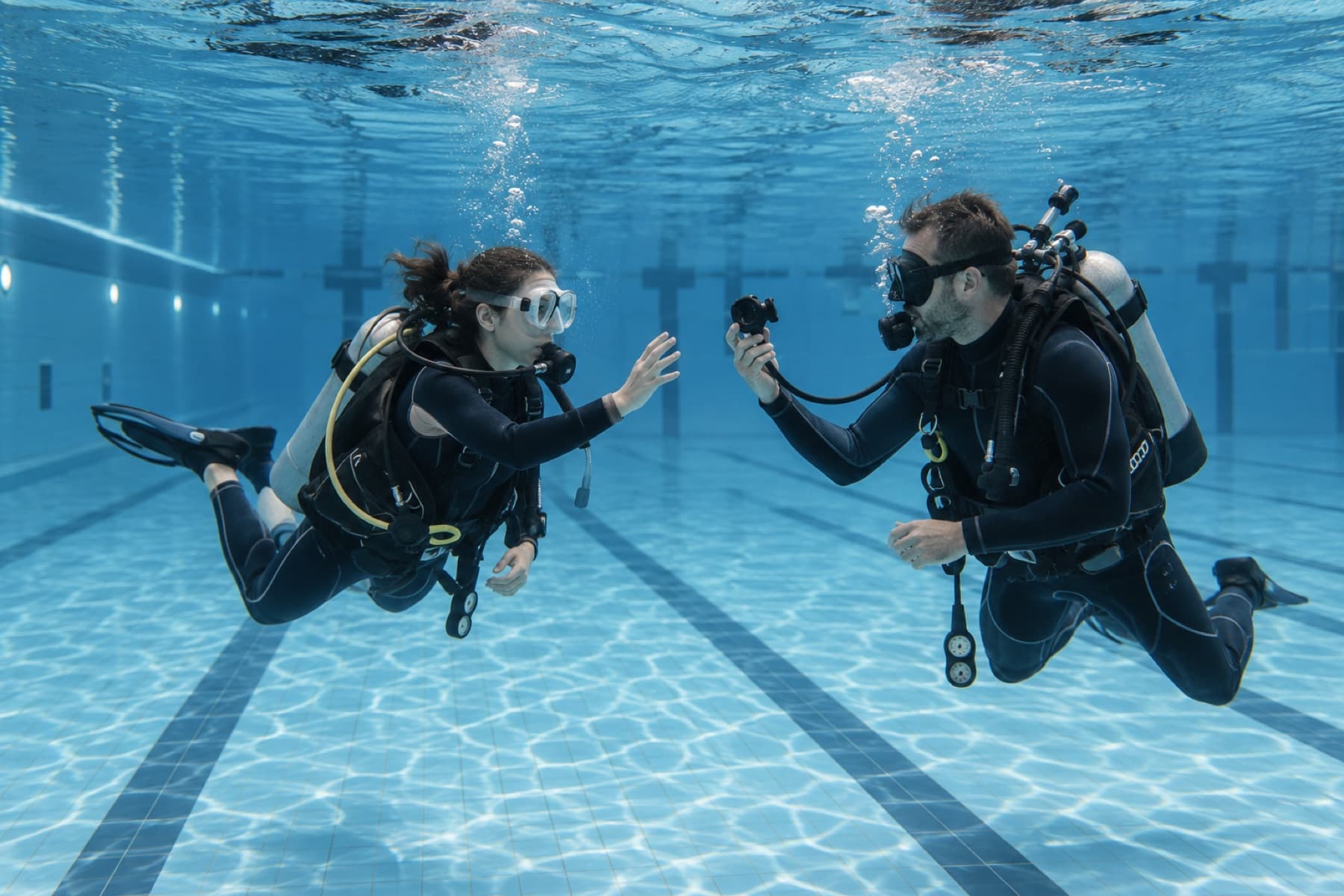
Theory and confined-water work are completed locally, usually in a pool. Open-water dives then require travel to a suitable coastal location, typically on the NSW south coast.
Splitting the course this way is not a compromise. It gives a student more time on skills than a compressed holiday course, and it means the qualifying dives happen in the conditions they will actually keep diving in.
Local fills and hydrostatic testing become important because Canberra divers cannot rely on dropping into a coastal shop for every service.
For the same reason, owning equipment tends to become more attractive to active club divers here sooner than it would for someone living ten minutes from a dive shop.
- air fills for local pool and coastal trips
- Nitrox and oxygen fills
- cylinder visual inspection and hydrostatic testing
- valve servicing
- regulator and BCD servicing
- drysuit and exposure-suit repair
Regular ocean diving from Canberra requires road travel, and travel is much easier to sustain when it is organised and shared.
An active club turns a three-hour drive from an obstacle into a normal weekend, which is why club structure deserves as much weight as course pricing when choosing an ACT centre.
2 businesses, grouped by region. Each profile records what is verified, what is advertised and what still needs checking with the operator.
Canberra
- Indepth ScubaA Canberra operation that functions as both a training school and a life-support service facility, with cylinder testing and a full range of gas fills.
- Lady of the Sea Diving AcademyA Canberra operation with an unusually complete set of facilities for an inland centre, including an onsite pool, classroom, retail shop and dive boat.
Frequently asked questions
Can I get fully certified in Canberra?
Yes. Theory and confined-water training are completed locally, and the open-water qualifying dives are conducted on a trip to the coast, usually the NSW south coast.
Is it worse to learn inland than at a beach destination?
Not inherently. Inland courses often spread training over more sessions, which gives students more time to become genuinely comfortable, and the ongoing local support after certification is a real advantage.
Where do ACT divers actually dive?
Most commonly the NSW south coast, including Jervis Bay and surrounding areas, along with organised trips further afield.
Can I get cylinder testing done in Canberra?
Yes — cylinder services including visual inspection and hydrostatic testing are among the core reasons inland centres exist. Confirm current capability and turnaround directly.