Australian diving guide
Types of Dive Businesses
Full-service centres, training schools, destination operators, charters, resorts and technical facilities are different things.
Australia does not have one public directory that represents every recreational dive centre, technical facility, resort operator, charter boat, equipment retailer and specialised instructor.
Agency locators naturally concentrate on their own networks. A PADI search emphasises PADI centres; an SSI directory emphasises SSI Training Centers; SDI and TDI cover another section of the market; RAID and IANTD become particularly relevant when advanced technical training is included.
A useful Australian directory therefore needs to work across agencies — and to distinguish between business types that serve genuinely different customers.
These combine several functions under one business, and they are particularly valuable for divers who want a long-term relationship with one local facility.
- training
- equipment sales
- rental equipment
- servicing
- gas fills
- club dives
- guided dives
- boat charters
Some businesses are heavily focused on education, ranging from small instructor-owned schools to large career-development operations.
The quality of training should not be judged solely by the number of courses advertised. Instructor experience, class size, training environment, equipment quality and how much time a student gets to become genuinely comfortable all matter more.
Some businesses exist primarily because of a particular dive destination, and for them daily local knowledge can be worth more than a large equipment showroom.
Examples include operators servicing Julian Rocks, Fish Rock, Wolf Rock, the SS Yongala, the Solitary Islands, Ningaloo, Lord Howe Island and the Tasman Peninsula.
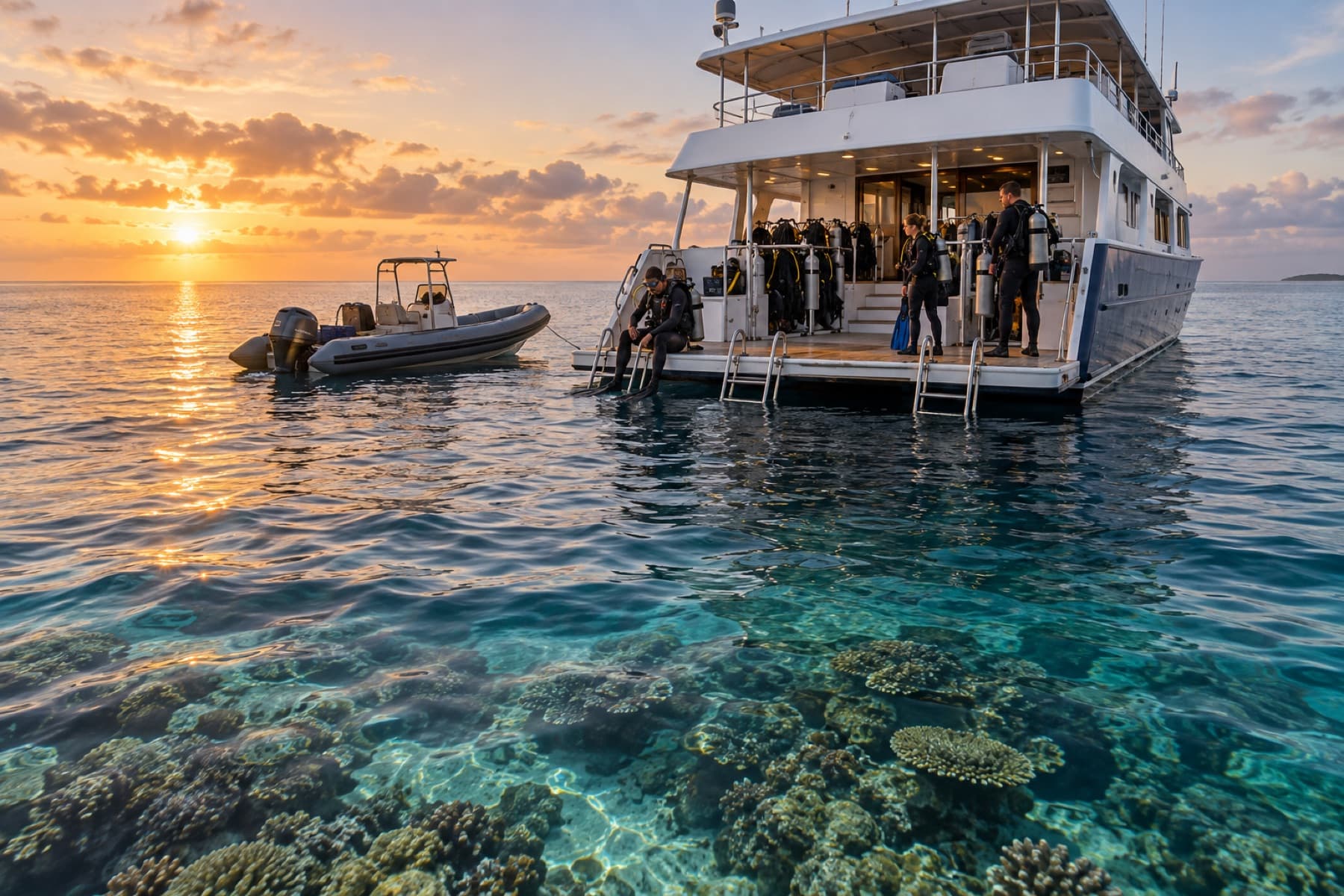
A boat operator may provide excellent diving without being a conventional training centre. What to compare is the vessel and the logistics rather than the shop.
- vessel and capacity
- passenger numbers on the day
- which dive sites are visited
- guide availability
- certification requirements
- Nitrox availability
- rental equipment
- emergency oxygen
- entry and exit systems
- travel time to sites
Resort operations offer accommodation, diving, equipment and training in one location, and are particularly common around tropical destinations and island stays.
Their convenience can be excellent for travelling divers, but their course and technical capabilities vary widely, and on island destinations some services require advance booking.
Technical facilities require separate evaluation, and a centre may offer only one part of the technical range.
- twinset
- sidemount
- stage cylinders
- Advanced Nitrox
- decompression procedures
- Trimix
- oxygen
- helium
- CCR
- technical DPV
- cave
- technical wreck training
A dive shop and a dive centre are not always the same thing. Some well-known Australian names are primarily equipment retailers, and several are oriented toward spearfishing and freediving rather than scuba.
They may still be the best place to buy equipment. They are not necessarily the place to book a course or get a regulator serviced.