
Technical training
Cavern Diver Course in Australia
Diving within the light zone of an overhead environment — the first genuine step into overhead training.
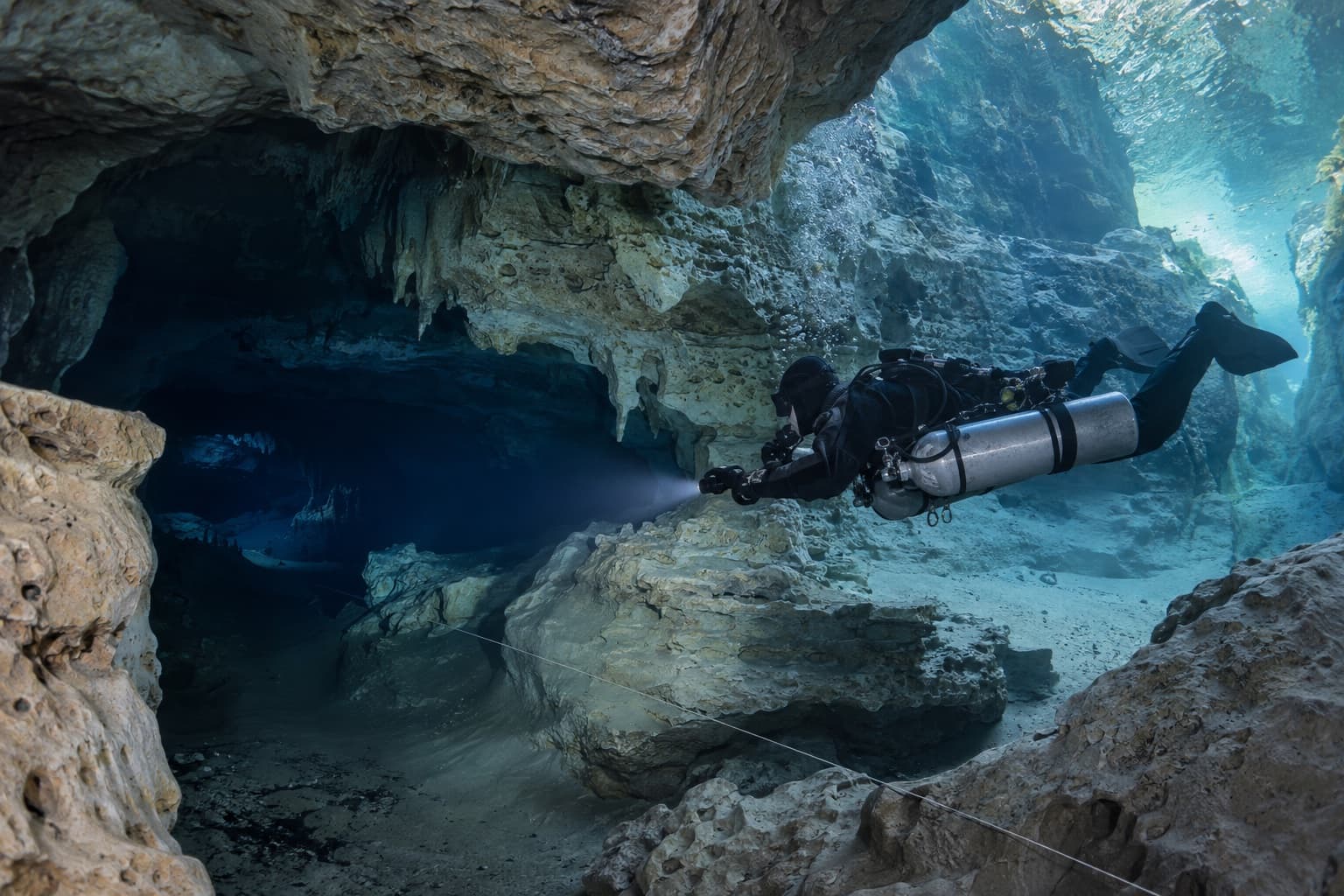

Cavern diving means staying within the natural light zone of an overhead environment, with the exit continuously visible and a guideline to open water maintained throughout.
It is the first genuine overhead qualification and the correct entry point for divers interested in Australia's sea caves, sinkholes and swim-throughs.
The distinction it enforces — between a route where you can always see the way out and one where you cannot — is the single most important idea in overhead diving.
| Track | Technical |
|---|---|
| Prerequisites | Advanced Open Water or equivalent; Good buoyancy control; Some agencies require a minimum number of logged dives |
| Agency equivalents | PADI: Cavern Diver · TDI: Cavern Diver · IANTD: Cavern Diver · CDAA: Deep Cavern |
- guideline use and continuous line to open water
- staying within the natural light zone
- light redundancy
- silt management and propulsion techniques
- gas management rules for overhead diving
- turn pressure discipline
Cavern diving keeps natural light and the exit continuously available. Cave diving deliberately goes beyond that, and the training, equipment and gas rules escalate accordingly.
Treating a cavern qualification as permission to go further is how overhead accidents happen.
In South Australia, the CDAA's site classification system governs access, and the qualification categories are the mechanism by which divers are permitted at particular sites.
Elsewhere — Tasmania's sea caves, Rottnest's swim-throughs, Fish Rock — cavern skills are relevant even where no formal access system applies.
Readiness
- Precise buoyancy, non-silting propulsion and team awareness should precede any overhead training.
- Cavern training remains within a daylight zone and is not permission for unrestricted cave penetration.
What to compare
- Compare limits on distance, visibility, gas, light zone and navigation rather than assuming every cavern card is equivalent.
- Australian access rules can add CDAA site and membership requirements beyond an agency qualification.
Useful outcome
- The diver should maintain a continuous guideline, protect visibility and turn the dive before any cavern limit is exceeded.
Questions to ask the instructor
- Which site and access system will be used?
- Does the course credit into Intro to Cave?
- Is all overhead equipment included?
Dive Sites for Cavern Diver Skills
Sites where holding this certification genuinely changes what you can do — not a list of everywhere it is accepted.
Courses After Cavern Diver
Courses that build directly on this one.
Cavern Diver Course Names by Training Agency
Agency versions and nearest equivalents. Names, prerequisites and limits can differ, so operators assess the exact certification and experience.
Australian Dive Centres Offering Cavern Diver
Businesses where the relevant capability is verified or advertised. Always confirm the specific course directly.
Cavern Diver Guides and Comparisons
Planning guides and comparisons connected to the skills on this course.
Cavern Diver Course FAQs
Do I need cavern training for Fish Rock Cave?
Operator procedures vary and the route determines the answer. The cave has a genuine overhead section, and discussing the planned route with the operator is essential.
Does this qualify me for Mount Gambier?
Access in South Australia is governed by CDAA categories. Check which category a specific site requires rather than assuming a cavern qualification covers it.
Sources
What the verified statements on this page are based on. We link primary sources so you can check them yourself — and so you can see the date they were consulted.
- TDI — current diver standardschecked September 2026
- CDAA — Cave Divers Association of Australiachecked September 2026