Marine life
Green Turtle
Chelonia mydas
The most commonly encountered turtle on Australian reefs, and a reliable sight at Cook Island and the southern Great Barrier Reef.
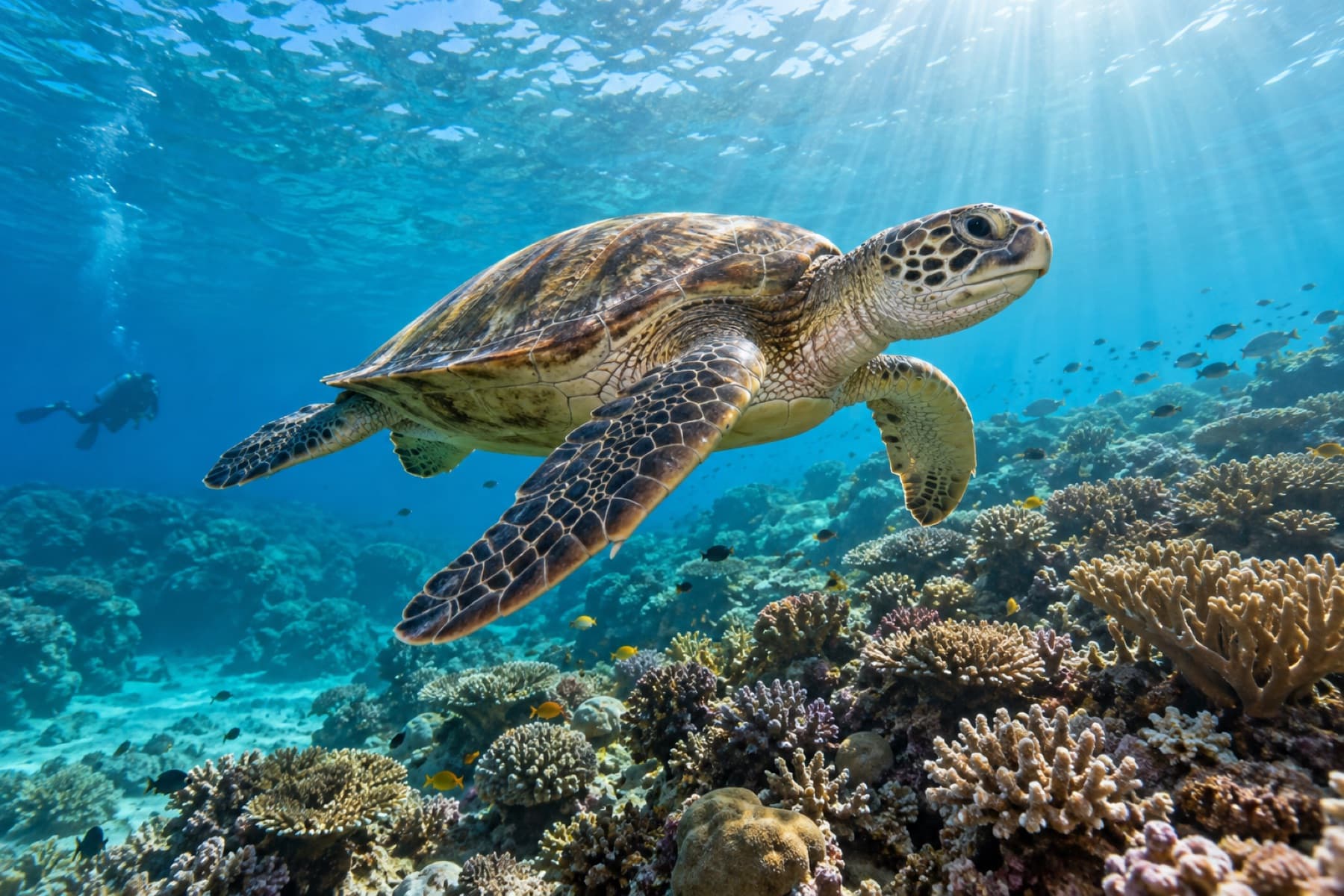
Green turtles are the turtle most Australian divers meet, and on the southern Great Barrier Reef cays and at sites like Cook Island they are close to guaranteed.
Adults are herbivorous, grazing on seagrass and algae, which is unusual among sea turtles and is where the name comes from — the green refers to the colour of the body fat, not the shell.
They rest under ledges and on the reef, and a resting turtle will often tolerate a diver at very close range provided nobody blocks its route to the surface.
| Scientific name | Chelonia mydas |
|---|---|
| Typical size | Shell commonly 80–120 cm |
| Conservation status | Endangered |
| Peak months | October, November, December |
| Documented sites | 9 |
| States | Queensland, New South Wales, Western Australia |
- single pair of scales between the eyes
- smooth, rounded shell, olive to brown with darker mottling
- blunt, serrated beak suited to grazing
- smaller head relative to body than a loggerhead
- Adults graze seagrass and algae; juveniles are more omnivorous.
- Rests under ledges and overhangs, often for extended periods.
- Nests on sandy cays and beaches, returning to natal beaches to breed.
In-water etiquette
Green Turtle is endangered. How divers behave around it genuinely matters.
- Never block a turtle's path to the surface — they are air breathers and this is genuinely stressful.
- Do not touch, ride or chase.
- Keep clear of resting animals under ledges; give them an exit.
- On nesting beaches, follow local rules on lights and distance.
Where to see them
Sites where this species is documented as a reliable encounter.
Operators servicing those sites
Businesses documented as diving the sites above. Confirm seasonality and requirements directly.
Often seen on the same dives
Frequently asked questions
Where is the best place to dive with turtles in Australia?
Cook Island off Tweed Heads and the southern Great Barrier Reef cays — Heron, Lady Elliot and Lady Musgrave — are the most reliable.
When do turtles nest on the Great Barrier Reef?
Roughly November to March, with hatchlings emerging from around January.
Last researched: September 2026. Dive businesses change frequently — confirm current services, prices and requirements directly with the operator before booking.